Quick answer: "epoxy floor paint" from the hardware store is a water-based product that is roughly 30–50% epoxy solids and dries to a film about 3 mils thick — about the thickness of a paint chip. A professional epoxy coating is 100% solids, builds to 20–30+ mils across multiple coats, and is applied over diamond-ground concrete. Paint costs $150–$400 per garage and commonly peels within 1–3 Canadian winters; a professional system costs $2,200–$3,800 for a double garage and lasts 15–25 years. Both have legitimate uses — but they are not the same product, and the marketing makes that genuinely confusing.
Why "Epoxy Paint" and "Epoxy Coating" Are Different Products
The word "epoxy" on a paint can refers to a chemistry, not a performance level. Hardware-store epoxy floor paint is a one-part or two-part water-based acrylic-epoxy hybrid. Water is the carrier: as it evaporates, what remains on your floor is a thin film of resin — typically 3 to 5 mils dry (a mil is one-thousandth of an inch). That film sits on top of the concrete rather than penetrating into it.
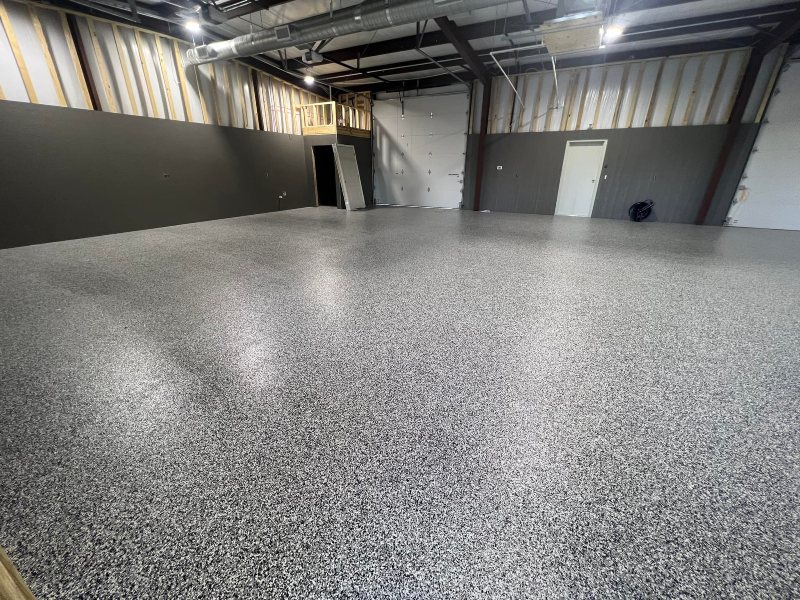
A professional coating is 100% solids epoxy — there is no water or solvent to evaporate, so every litre that goes down stays on the floor. A typical residential system is a primer that wicks into the ground concrete, a high-build epoxy body coat, a full broadcast of vinyl flake, and one or two coats of polyaspartic on top. Total build: 20 to 30+ mils, bonded into a mechanically ground surface. That is five to ten times the material of a painted floor, with a chemically superior resin at every layer.
The Real Reason Paint Peels: Surface Preparation
In our years coating garage floors across the GTA, nearly every failed DIY floor we are called to fix shares the same root cause — and it is usually not the paint itself. It is what is underneath. Concrete leaves the trowel with a smooth, dense surface layer called laitance, and builders spray curing compounds on new slabs. Neither accepts a coating. The kit instructions say "clean and etch with the included acid" — but acid etching cannot remove curing compound, old sealers, or oil contamination, and it leaves a weak, chalky surface behind.
Professional installers diamond-grind the slab to a CSP 2–3 profile (Concrete Surface Profile — an industry standard roughness scale). Grinding removes laitance, sealers, and contamination entirely and opens the concrete's pores so the primer locks in mechanically. This single step is the difference between a coating that becomes part of the floor and a film that sits on it waiting for a reason to let go. The reason usually arrives in the form of a hot tire.
Hot Tire Pickup: How Canadian Winters Kill Painted Floors
Drive home in January and your tires arrive warm. Parked on a painted floor, that heat softens the thin film; as the tire cools and the rubber contracts, it grips the softened paint and physically peels it off the slab. Installers call it hot tire pickup, and it is the number-one failure mode of epoxy floor paint in Canada — usually showing up as two bald rectangles exactly where the car parks. Add road salt, which creeps under the paint film at every pinhole and edge, and freeze-thaw cycling that flexes the slab all winter, and a 3-mil film simply has no chance. A 25-mil professional system over ground concrete is not affected: there is too much build to soften through, and the bond is mechanical, not superficial.
Cost Comparison: Paint vs. Professional Coating in Canada
Here is the honest math for a typical double garage (about 450 sq ft) in the Greater Toronto Area:
- —Epoxy floor paint kit (Rust-Oleum, Behr, KILZ class): $150–$400 in materials, plus a weekend of your labour. Expected life on a driven-on garage floor: 1–3 years before visible peeling. Cost per year: roughly $100–$250, plus the eventual cost of stripping it.
- —Professional full-flake system: $2,200–$3,800 installed ($5–$9/sq ft), including grinding, crack repair, moisture testing, and a written warranty. Expected life: 15–25 years. Cost per year: roughly $120–$220 — comparable to paint, with no weekend lost and no redo.
- —The hidden third cost: recoating over failed paint. Old paint must be completely ground off before a proper system can go down — removal adds work to any future professional install. A painted floor is not a stepping stone to a coated floor; it is an obstacle to one.
Rule of thumb: if the floor never sees a parked car — a furnace room, a storage area, a workshop on foot traffic only — quality epoxy paint is a perfectly reasonable budget choice. If a vehicle parks on it through an Ontario winter, paint is a 1–3 year product. Plan accordingly.
When Epoxy Floor Paint Is Actually the Right Choice
We install coatings for a living, so take this for what it is worth: paint is not always the wrong answer. A rental property you are refreshing before listing, a basement utility room, a shed floor, a temporary fix before a renovation — these are sensible places for a $200 kit. The product fails under tires, salt, and moisture; in their absence it can look respectable for years. Buy a two-part (catalyzed) kit rather than a one-part product, clean the slab obsessively, and accept the lifespan for what it is.
How to Tell What a Contractor Is Actually Quoting You
Confusingly, some low-priced "professional epoxy" services roll on the same thin products you can buy yourself. Three questions expose the difference instantly:
- 01How do you prepare the concrete? The only acceptable answer involves diamond grinding (or shot blasting for large commercial floors). "Acid etch" or "power wash" means you are paying contractor prices for paint-grade prep.
- 02What is the total system build in mils, and is the epoxy 100% solids? A real system is 20+ mils and the installer will know the number without checking. Vague answers are an answer.
- 03Is hot tire pickup covered in the written warranty? Installers using proper systems cover it explicitly, because with correct prep it does not happen. Anyone who excludes it is telling you what product they use.
The Bottom Line
Epoxy floor paint and professional epoxy coating share a word, not a performance class. Paint is a thin decorative film that suits dry, no-vehicle spaces and short time horizons. A professional 100% solids system over diamond-ground concrete is a 15–25 year building upgrade that happens to look spectacular. For a Canadian garage that sees tires and salt, the choice usually makes itself — but now you know exactly why, and exactly what to ask whoever does the work. If you are in the Greater Toronto Area, we are happy to look at your slab and tell you honestly which one your project needs — even if the answer is a $200 kit.
Pure Coatings Epoxy
GTA Epoxy & Concrete Flooring — Est. 2024