
Quick answer: epoxy and polyurethane are not competitors — they are different layers of a good floor. Epoxy is the build coat: thick, hard, and ferociously bonded to concrete, but it yellows in sunlight and scratches under abrasion. Polyurethane (urethane) is the wear coat: thinner but flexible, scratch-resistant, chemical-resistant, and UV-stable. The best residential and commercial floors use epoxy for the body and a urethane-family topcoat for the surface. In our GTA installs, that topcoat is usually polyaspartic — a fast-curing member of the polyurethane family built for Canadian conditions.
What Epoxy Does Best
Epoxy is the structural half of the partnership. A 100% solids epoxy body coat goes down at 10–20 mils in a single application, bonds into diamond-ground concrete with tremendous adhesive strength, and cures into a rigid, high-compressive-strength layer that levels minor slab imperfections and carries the decorative flake or metallic pigment. Nothing else in the price range builds thickness and grip like epoxy. Its weaknesses are equally clear: UV exposure turns it amber within months (ask anyone with a south-facing garage door), its rigid cure can scratch and scuff under grinding abrasion, and it needs days, not hours, to cure.
What Polyurethane Does Best
Polyurethane cures into a thinner (2–4 mil) but tougher film — think of it as the clear coat on a car. It flexes microscopically instead of scratching, shrugs off abrasion and chemicals, and aliphatic formulations are permanently UV-stable: no yellowing, ever. The trade-offs: urethane cannot build thickness, its adhesion to bare concrete is mediocre (it wants to bond to a coating, not a slab), and solvent-based versions carry strong odours during application. Used alone on concrete, polyurethane is the wrong tool. Used over epoxy, it is the perfect shield.
Where Polyaspartic Fits — and Why We Use It Most
Polyaspartic is technically an aliphatic polyurea — a modern branch of the polyurethane family engineered to fix urethane's two practical headaches: slow cure scheduling and cold-weather limits. It delivers the same UV stability and abrasion resistance, but it is walkable in hours, drive-ready in about a day, and cures reliably down to -10°C, which standard products cannot. It also resists road-salt chlorides exceptionally well. That combination is why nearly every floor we install in the GTA — garage, basement, or commercial — finishes with polyaspartic rather than conventional urethane. Same family, better fit for Ontario.
Head-to-Head: The Practical Differences
- —Thickness per coat: epoxy 10–20 mils; polyurethane/polyaspartic 2–6 mils. Epoxy builds the floor; urethanes finish it.
- —UV stability: epoxy yellows; aliphatic polyurethane and polyaspartic never do.
- —Scratch and abrasion resistance: polyurethane and polyaspartic clearly better — their slight flexibility absorbs what scratches rigid epoxy.
- —Adhesion to concrete: epoxy clearly better — it is the only one of the three we trust as a primer/base on a slab.
- —Chemical resistance: all three are strong; urethane-family topcoats handle hot tire plasticizers and road salt best.
- —Cure time: epoxy 7 days to full cure; polyurethane 3–5 days; polyaspartic 1–3 days and usable far sooner.
- —Cold-weather installation: polyaspartic only (to about -10°C); epoxy and standard urethane stall below ~10°C.
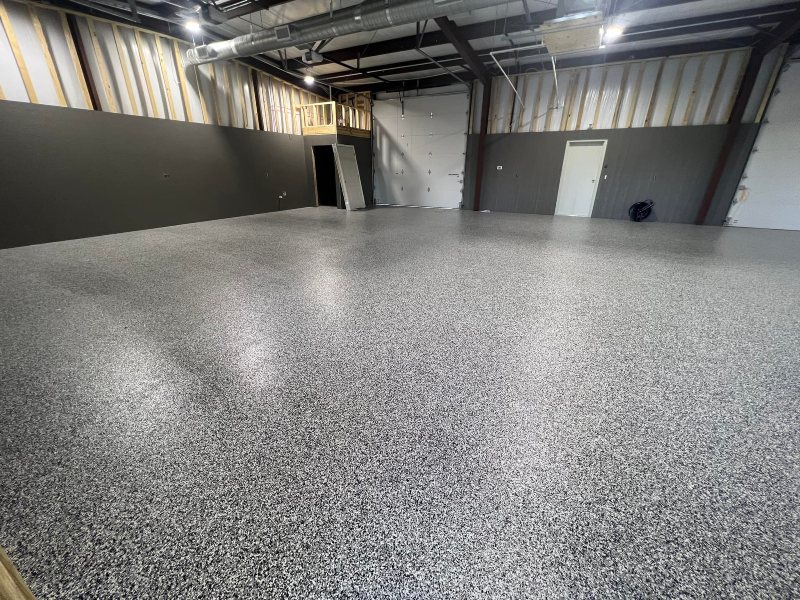
The system that wins for Ontario garages: 100% solids epoxy base coat (adhesion + build) → full vinyl flake broadcast (texture + looks) → polyaspartic topcoat (UV, salt, scratch protection, fast cure). Each chemistry doing the one job it is best at.
When Would You Use Just One?
Epoxy alone makes sense in spaces with zero UV exposure and gentle traffic — interior storage rooms, some warehouse zones — where its lower cost per mil wins. A urethane or polyaspartic-only system (applied as primer and topcoat in thin coats) makes sense when schedule is everything: a commercial space that can only close overnight, or a winter install in an unheated garage. For everything else — which in our experience is most residential garages and basements in the GTA — the hybrid system outperforms either chemistry alone, and the cost difference over a single-product floor is small compared to the lifespan difference.
The Bottom Line
Asking "epoxy or polyurethane?" is like asking "foundation or roof?" — a good floor needs both, each where it belongs. Epoxy supplies the bond and the body; a urethane-family topcoat supplies the armour; and in Canada, polyaspartic is the version of that armour that also solves winter scheduling. If a quote you have received specifies only one chemistry for the whole system, ask why — and if you are in the Greater Toronto Area, we are glad to walk you through exactly what we would put on your slab, layer by layer, at a free assessment.
Pure Coatings Epoxy
GTA Epoxy & Concrete Flooring — Est. 2024